kiInsight.ai — Personal Health Intelligence
See what your blood is telling you.
Upload a lab panel you already have. kiInsight reads every marker against the standard range — and many against a tighter optimal zone — then a short questionnaire sharpens the reading to your body. What comes back is a report: what's off, why, and what to do about it, food first.
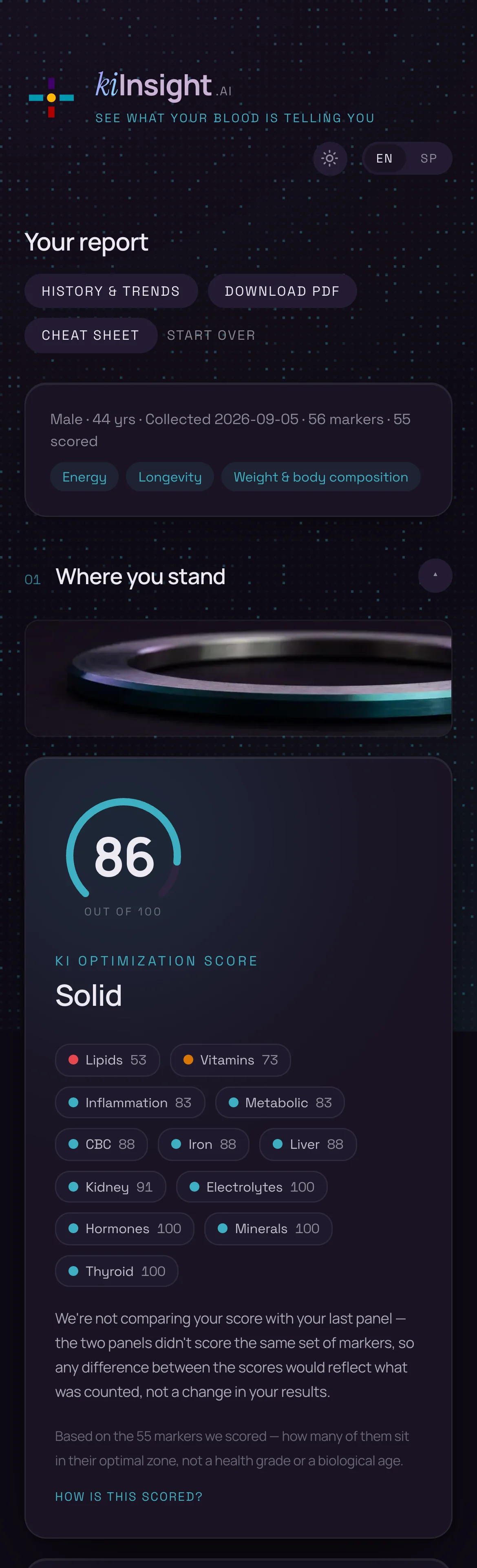
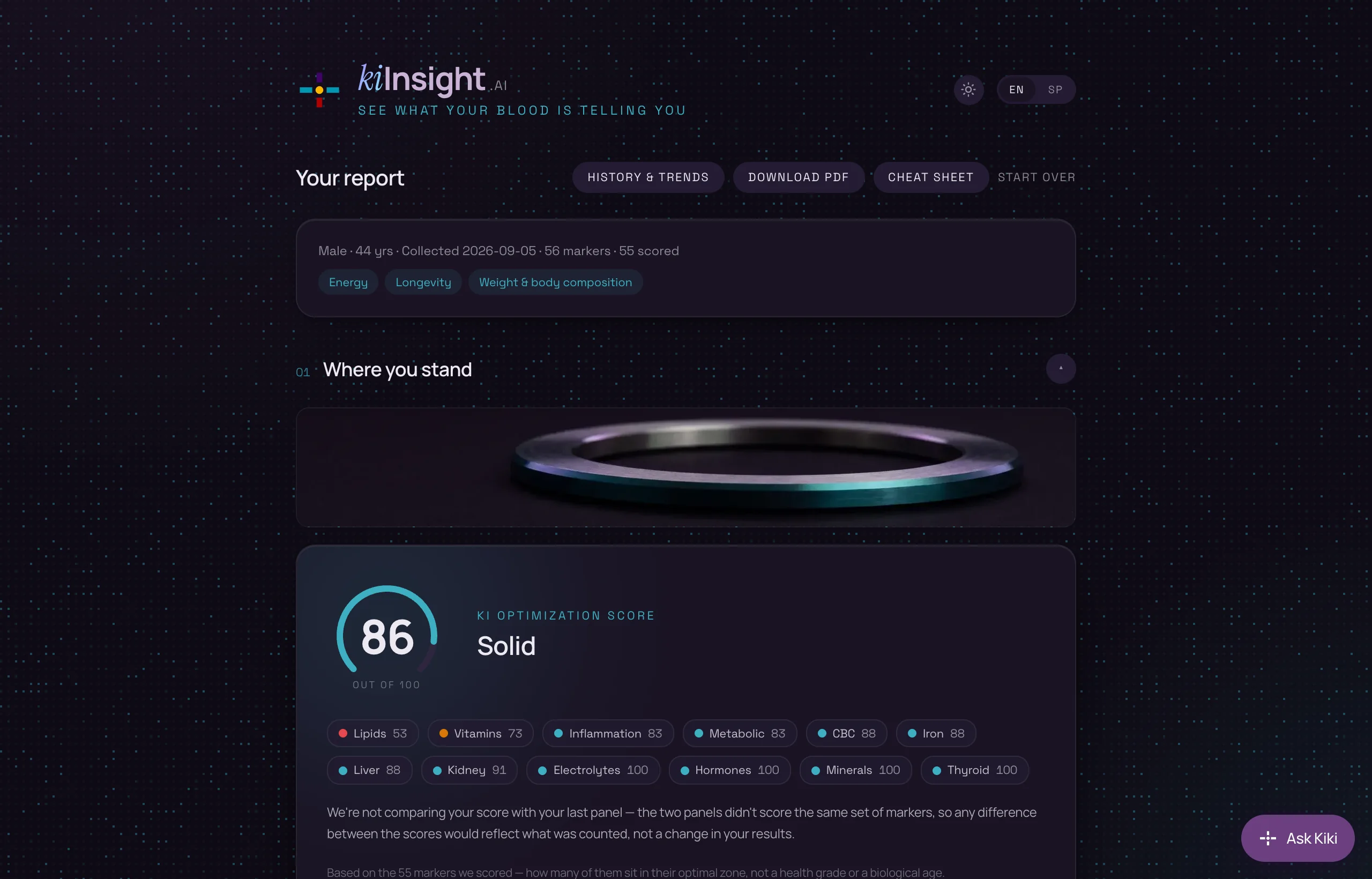
Every number and screenshot on this page comes from the built-in sample report — a 44-year-old man's 56-marker panel, run through the real engine — not a mockup.
01 — The report
Not a mockup. The actual report.
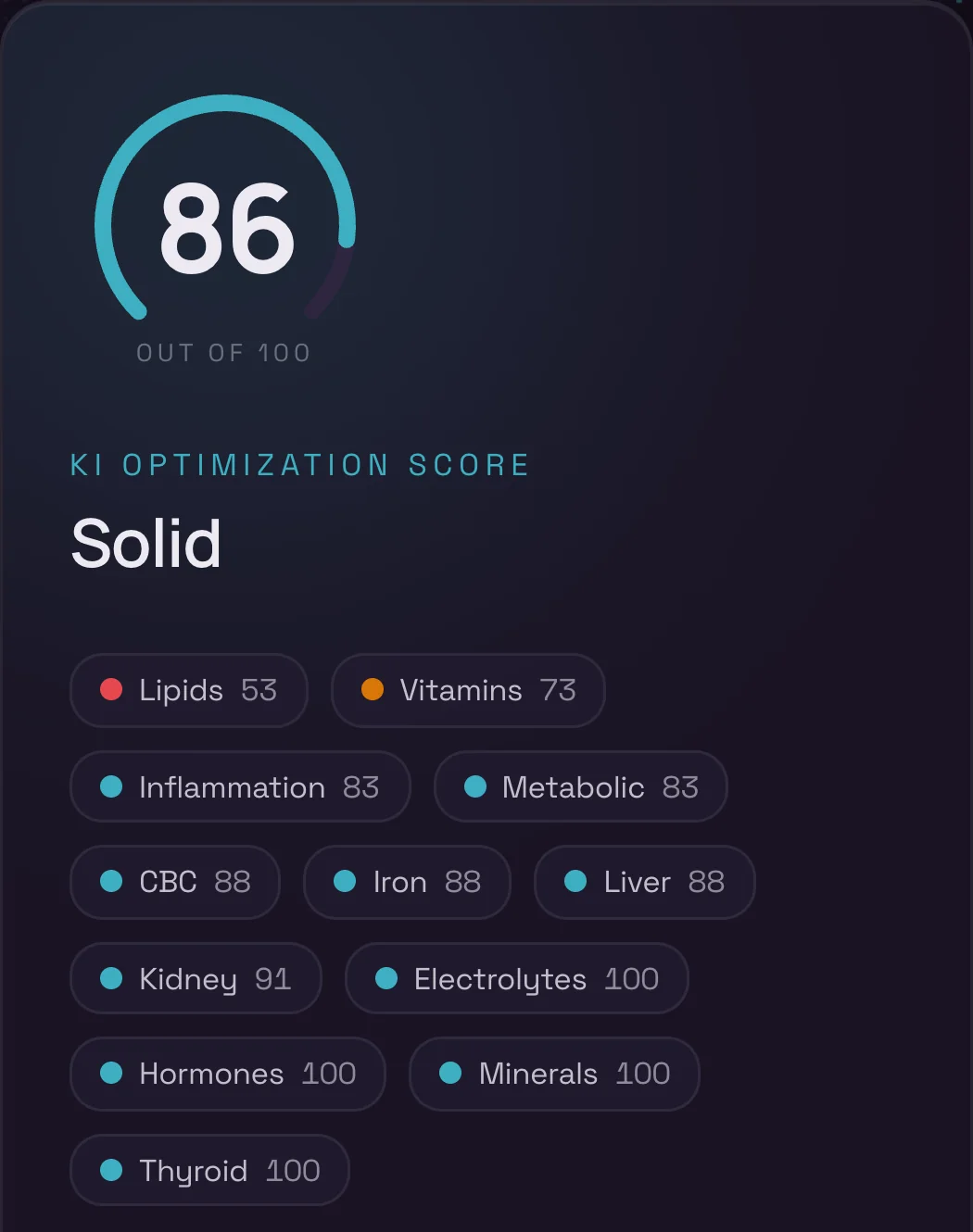
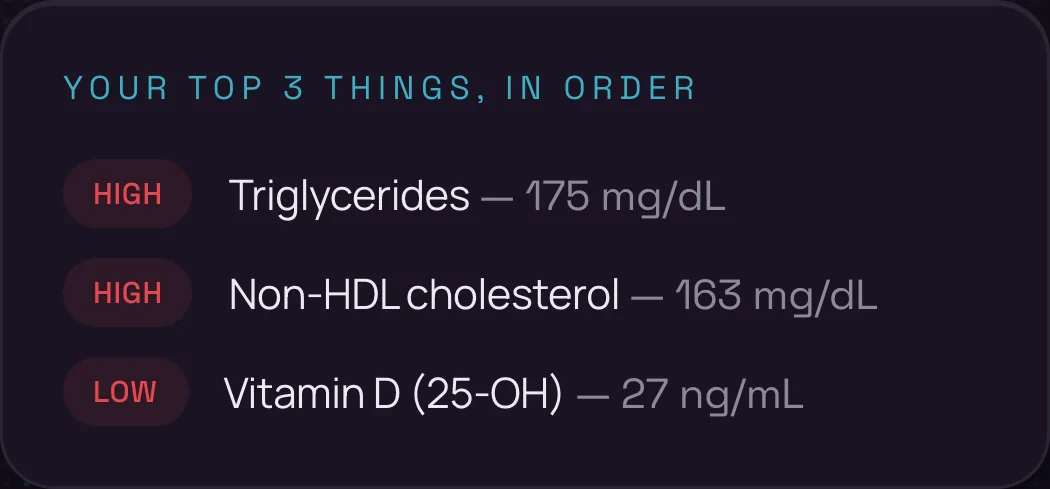
Here is where it starts: one score, twelve systems, and the three things to look at first. Then the report keeps its promise — every section below shows its work.
02 — How it works
Four screens between a PDF and a plan.
No new labs required. The results you already have, read properly.

Drop in your labs
A lab PDF, or screenshots of your results. If your provider's app won't export a PDF, screenshot the pages and select them all at once.

Confirm every value
Extraction uses AI, but you confirm every value before anything is calculated. Nothing is graded until you do.

A few questions
Context changes what a number means. Goals, symptoms, medications, supplements, sleep, cycle phase — all optional, all sharpening the read.

Your report
Seven sections in a fixed order — where you stand, findings, all results, over time, your protocol, peptides, references — and Ask Kiki beside them all.
03 — Findings
Patterns, not isolated flags.
A finding is drawn from your values and your answers together — and it shows its work: the markers that support it, the answers it's associated with, and the moves that follow.
- 3.1Supported by
Each marker behind the finding, with its value, its bar, and where it sits: above optimal, or above the standard range.
- 3.2Associated with
The intake answers that changed the reading — an elevated waist, a family history of type-2 diabetes, frequent sugar cravings, recent weight gain.
- 3.3Nutrients recommended
Food first, then lifestyle, then supplements — each tagged with its evidence grade. The full plan, with doses, waits in your protocol.

04 — All results
Two ranges, not one.
Your lab prints one standard range — wide enough that you can sit inside it and still feel off. kiInsight adds a tighter optimal zone on the markers that have one: the teal segment of the bar. No teal segment? The standard range is the whole grade, and the card says so.
- 4.155 of 56 markers scored
The other is read but not graded — and the report tells you which, instead of quietly dropping it.
- 4.2Every marker carries a note
Inside its zone or out. Nothing is left blank, because "normal" is sometimes the most important thing on the page.
- 4.3Twelve systems, twelve scores
Metabolic, lipids, thyroid, inflammation, iron, liver, kidney, electrolytes, minerals, vitamins, hormones, CBC — each graded on its own.

05 — Your protocol
Food first. Lifestyle second. Supplements third.
Your findings, turned into a sequence. Phase 1 is a focused handful — your strongest deviations, and any dose computed from your own result — so that when you retest, you can tell what actually moved the number. The rest follow in priority order. Nothing is truncated; it's ordered.


06 — Over time
Did it work?
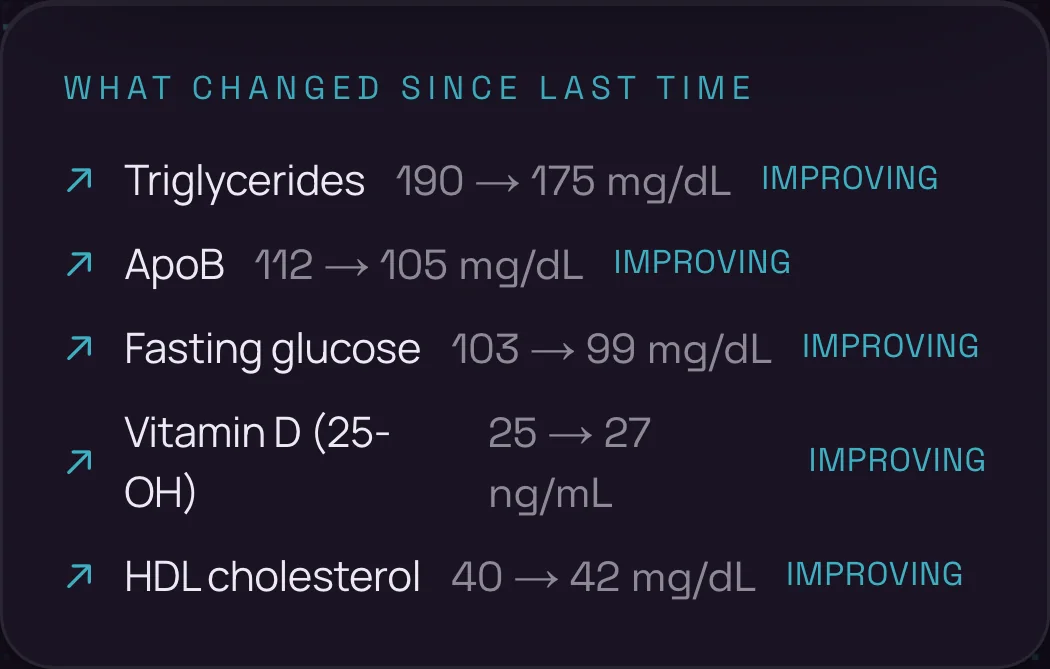
Every panel is a timestamped snapshot. The report shows how each marker moved toward — or away from — the zone it's graded against, and grades each move against the expectation it published at the time. Not one invented afterwards.


07 — Ask Kiki
Ask anything. Grounded answers.
Ask about any marker — or how nutrition, supplements, lifestyle, fitness, and peptides relate to your results. Every answer is grounded in your confirmed values and the cited knowledge base. No guessing on your numbers.
"Start with your triglycerides (175, above the standard ceiling of 150), then non-HDL cholesterol (163, just over the 160 line), then vitamin D (27, a bit under the 30 floor). The reason these come first is that your panel shows an early blood-sugar/insulin-resistance pattern…"
Asked on the sample report: "What should I focus on first?" The three it names are the report's own top three, in the report's own order.
08 — Peptide Protocol
Peptides come last — and without doses.
The last section of the report, by design. The engine assembles research topics from your panel and questionnaire into a suggested reading path — strongest signals first, in cycles across the year. A suggestion to explore, not a recommendation, not a prescription.
- 8.1Every topic says why you're seeing it
The markers behind it, in plain words — "your glycemic markers came back above the optimal zone."
- 8.2No dose, frequency, or route in public
Nowhere in the section, by design. These are reading topics in a suggested order.
- 8.3Members see what the research used
Doses, cycles and timing appear only when you're signed in — separate from your nutrient protocol, and still not a prescription. kiInsight doesn't sell any of them.

09 — Take it with you
Yours to keep, in two languages.
Download PDF · Cheat sheet · History & trends
The whole report as a PDF, a short take-away sheet for the fridge or your provider, and every saved panel on a timeline.

English and Spanish
Every section, every card, every note — the same report in both, switchable in one tap.
References
Every citation the report used, in one appendix at the end — the ranges, the trials, the guidance behind each move.

10 — The rules it keeps
What it refuses to do.
The confidence in a report comes from what it won't say. These are built into the engine, not written into a policy.
Diagnose
Educational information, not medical advice — not a diagnosis. Optimal ranges are educational targets, not diagnostic cutoffs, and every printed page says so.
Invent an optimal zone
Where a marker has no defensible optimal target, the standard range is the whole grade — and the card says so rather than drawing a teal segment anyway.
Call noise a win
A change smaller than a marker's own draw-to-draw swing reads "can't tell yet," even when the number moved the way you hoped.
Compute a dose it can't show
The one dose calculated from your result prints its arithmetic and its upper limit. Every other dose is labeled a standard dose, not computed for you.
Hide what it held back
When a rule withholds a move — a medication, a condition, a screen — the report keeps the card in "Held back, and why" and states the reason.
Sell you anything
kiInsight does not sell supplements, peptides, or lab tests. The report's only product is the reading.
11 — Early access
The waitlist is the filter.
Access is private and opens in small cohorts, so every member gets a first report walked through, not just delivered.
- Founding-member pricing, locked for as long as you stay.
- The live platform — upload, confirm, the intake, the full report, your protocol, Ask Kiki, PDF and cheat sheet, English and Spanish.
- Concierge onboarding — your first report read with you, section by section.
12 — Questions
Asked and answered.
A reader for lab results you already have. You upload a panel, confirm every extracted value, answer a short optional questionnaire, and get a report: a score, findings drawn from your values and answers together, every marker graded against its standard range and — where one is defensible — a tighter optimal zone, a protocol that starts with food, a peptide reading list at the end, and Ask Kiki to interrogate all of it.
No. kiInsight is educational information, not medical advice and not a diagnosis. Optimal ranges are educational targets, not diagnostic cutoffs. When a finding belongs with a clinician, the report says "see a provider" — and it never diagnoses or treats.
No. Start with any recent panel — a lab PDF, or screenshots of your results if your provider's app won't export one. Extraction uses AI, but you confirm every value before anything is calculated. You can also open the built-in sample panel and read a full report before uploading anything.
Each one has a source, listed in the References section of your report. Markers without a defensible optimal target are graded against the standard lab range alone, and the card says so. Every marker also carries a plain-language note on what it is and why it matters.
They come last in the report, on purpose, and the public section carries no dose, frequency, or route — it's a reading list in a suggested order, with the markers behind each topic. Signed-in members see what the research used, separate from the nutrient protocol and still not a prescription. kiInsight doesn't sell peptides, supplements, or lab tests.
Founding-member pricing is announced to the waitlist first, and early members lock their rate for as long as they stay.
It stays yours. We do not sell your data, we do not run ads, and we never use your health information for marketing. Data is encrypted in transit and at rest, readable only by your account and anyone you have explicitly been linked with, and you can delete any saved panel in the app at any time. The full policy is one click away in the footer.